About
Safe, Seen, Supported is a trauma-informed workshop for educators who want to deepen their understanding of how adversity shapes children’s development, behaviour, and relationships.
Grounded in contemporary neuroscience, humanistic psychology, and the Phoenix Cups Framework, this workshop explores how trauma impacts the developing brain, particularly stress-response systems, and how children’s behaviour reflects their best attempts to meet their needs with the skills and capacities available to them in the moment.
Rather than focusing on behaviour management, educators are supported to create environments that prioritise safety, connection, and empowerment. We unpack different types of trauma, recognise signs of survival states, and explore how predictable routines, relational regulation, and attuned interactions can buffer stress and support healing.
With a strong focus on practice, the workshop highlights the brain’s capacity for neuroplasticity and the vital role educators play in fostering calm, responsive, and inclusive learning environments. Educators leave with practical, evidence-informed strategies aligned with the National Quality Standard and Child Safe Standards, and renewed confidence in their role supporting children to thrive.
We will
- Develop a clear understanding of trauma, survival states, and the key neurological systems involved, using accessible neuroscience and real-world early childhood examples.
- Explore how trauma impacts children’s needs for safety and connection, and how predictable, relational environments can buffer stress and support regulation.
- Engage with practical, trauma-informed strategies that prioritise co-regulation, attuned interactions, rhythms and rituals, and children’s autonomy.
- Participate in collaborative reflection and problem-solving to support educators to embed trauma-informed, needs-meeting practices within their unique service context.


Participant Outcomes
By the end of the workshop, participants will have:
- A comprehensive understanding of how trauma impacts the developing brain, behaviour and learning.
- The ability to recognise signs of stress and survival states in young children without pathologising or labelling them.
- Practical, relational strategies for supporting children through co-regulation, predictability and empowerment.
- Confidence in using the Phoenix Cups Framework to identify unmet needs and design supportive responses.
- The skills to reflect critically on their own pedagogy and make intentional changes that strengthen children’s sense of safety, trust and belonging.
Theoretical Underpinnings
Neuroplasticity & Stress-Response
Dr Parisa Gazerani
Demonstrates how the brain changes through relationships, modelling and predictable environments, underpinning the workshop’s focus on co-regulation and healing through connection.
Guidance Approach
Dr Louise Porter
Focuses on children being supported rather than controlled, prompting educators to respond with empathy, skill-building, and relationship-based practice rather than consequences or rewards, using empathy proactivity to support children’s skill development.
Self-Determination Theory
Ryan & Deci
Children thrive when their core psychological needs are met. Children’s wellbeing grows when environments actively support autonomy, competence, and relatedness as the foundations of children’s capacity to learn, relate, and regulate.
Theory of Constructed Emotion
Dr Lisa Feldman-Barret
Children learn to understand their unique emotional experience through exploration of their world, sensory input and exploration and rich interactions with adults and peers. Enriching children’s emotional vocabulary and modelling regulation, educators support brain and emotional development.

National Alignments
Quality area 1 – Educational Program and Practice (Elements 1.1.1, 1.2.1, 1.2.2): Strengthens intentional, responsive and attuned practices that promote holistic wellbeing.
Quality area 2 – Children’s Health and Safety (Elements 2.1.1, 2.2.1, 2.2.3): Supports environments that prioritise emotional safety, co-regulation and trauma-informed risk reduction.
Quality area 5 – Relationships with Children (Elements 5.1.1, 5.1.2, 5.2.2): Deepens educators’ capacity to form trusting, respectful relationships that foster children’s emotional security and self-regulation.
Standard 1.1 – Physical, social and intellectual development: Deepens understanding of how trauma affects learning, behaviour and development.
Standard 1.2 – Know learners and how they learn: Strengthens educator insight into children’s stress responses, needs and regulatory capacities.
Standard 4.1 – Support student participation: Supports inclusive, responsive environments where all children can engage safely and confidently.
Standard 4.3 – Manage challenging behaviours: Reframes “challenging behaviour” as stress-related needs, promoting guidance-based, trauma-informed approaches.
Principle 1 – Child safety and wellbeing are embedded in organisational leadership, governance and culture
- Encourages leaders to prioritise emotional safety and relational pedagogy so that wellbeing is considered in every policy, routine and interaction.
- Supports services to design predictable, calm environments that reduce stress, uphold children’s rights and promote trust.
Principle 3 – Children are empowered and participate in decisions affecting them
- Promotes everyday practices that offer children meaningful choice and agency, helping them rebuild control after experiences of stress or adversity.
- Models language that invites children into shared problem-solving, strengthening their sense of belonging and contribution.
Principle 5 – People working with children are suitable and supported
- Encourages ongoing reflective practice to help educators recognise personal triggers, biases and assumptions that may influence interactions with children.
- Strengthens staff capability through trauma-aware knowledge, increasing confidence in responding to children’s distress with calm, attuned presence.
Principle 8 – Staff are equipped with knowledge, skills and awareness to keep children safe
- Builds educators’ understanding of trauma signs, stress responses and survival states, enabling early identification of when children need extra support.
- Supports staff to use co-regulation, modelling and predictable relational strategies to prevent escalation and maintain emotional safety for all children.
Culturally Safe, Inclusive & Responsive Programs
- Builds educator capability to create emotionally safe, culturally attuned environments for all children.
- Supports equitable access to co-regulation and relationally rich experiences that buffer stress.
Embedding Aboriginal and Torres Strait Islander Perspectives
- Encourages practices grounded in connection, belonging and community healing.
- Promotes educator reflection on colonisation’s intergenerational impacts on safety and wellbeing.
Equity and Access for All
- Supports universal design approaches that benefit all children, especially those experiencing adversity.
- Strengthens educator reflection on bias, assumptions and decision-making that affect participation.
Social & Emotional Learning
- Deepens educator understanding of stress, emotions and behaviour so children experience co-regulation and safety.
- Builds capacity for attuned, trauma-aware interactions that foster resilience, empathy and emotional growth.
- Supports predictable routines and rituals that strengthen children’s needs for security and connection.
Access & Inclusion
- Strengthens educators’ ability to reflect on biases, assumptions and decisions that influence children’s access to safe, nurturing environments.
- Supports trauma-informed adjustments that enable equitable participation for all children.
Communication (Language Development)
- Builds children’s emotional vocabulary and capacity to express needs safely and confidently.
- Strengthens interactions that model attuned language, reflective listening and co-regulatory dialogue.
Wellbeing (Social & Emotional)
- Enhances educator understanding of trauma, stress and co-regulation to support emotional wellbeing.
- Builds predictable, relational environments where children feel secure enough to explore, learn and connect.
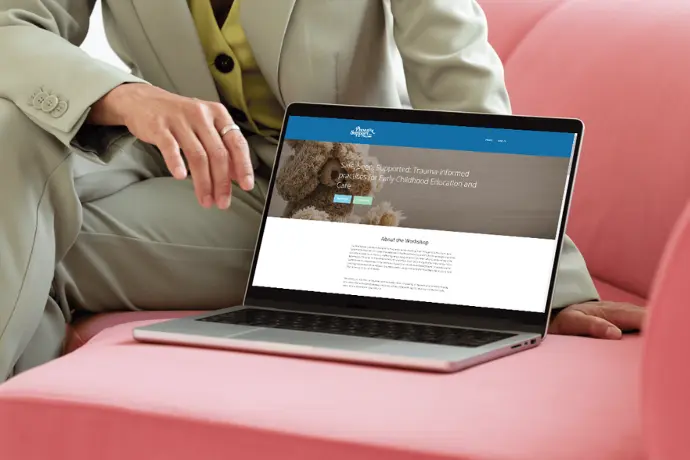
Online course option
Prefer to engage in this training from the comfort of your own home? We get it!
That's why we created the self-paced online course, with video content and downloadable workbooks.

More on the neurological impact of trauma
Interested in the neurological impact of trauma? You can read all about it in our blog.