
First, the numbers
In August 2019 we put the Phoenix Cups Quiz online and hoped a few people might have a go.
A few hundred thousand of you came to have a look, and more than 116,000 of you finished it.
Educators, leaders, parents, whole teams at a staff meeting, and all of the friends and family you made do it too 😉. That's seven years of quizzes. Thank you. Every one of you.
About 14,400 of you came back and did it again. Some of you waited a year or two. Some of you, we suspect, did it again straight away because you weren't sold on your result. Fair enough.
And about 640 of you have done the quiz five or more times! A few of those are shared centre logins, so we won't be too precise about it. But some of you are just keen. You know who you are 😉
Which Cup came out on top?
We went back through every quiz and asked one question. Which Cup was most likely?
Most likely dominant Cup
Hover over or tap a Cup to see its share.
Safety took the top spot. Nearly three in ten of you have Safety as your biggest Cup. Connection came next, then Fun, then Mastery.
Freedom came last. About one in eight.
Quick note on how we counted. If you tied with two dominant Cups, say 8 for Connection and 8 for Mastery, we counted you once for each. If you got 8 for Connection and 7 for Mastery, you went in the Connection slice only.
So, are big Freedom Cups® rare? Maybe. Or maybe, and we think this is more likely, a lot of you did the quiz because your boss asked you to. Except the Freedom Cups. A Freedom Cup only does a quiz when it's their idea, thank you very much 😉
Does your job show in your Cups?
The quiz also asked about your job. A sample of the data told us something interesting.
Here it is.
Dominant Cup by job
Pick a Cup, then switch between job level and industry.
Mastery climbs the ladder. Among support staff, Mastery was dominant for fewer than one in ten. Among upper managers, more than one in five. Every step up, a few more dominant Mastery Cups®.
Freedom barely moves from job to job. With one exception. If you're self-employed, Freedom jumps to about one in four, double everyone else (so on brand for a Freedom Cup). And in the small group who work in arts, entertainment and recreation, Freedom came first (that also tracks). The only group where it did.
Homemakers were the most Safety-heavy group of all, with Mastery the smallest.
And educators? You look exactly like the big pie chart above. Which makes sense. Two thirds of the people who did the quiz work in education. That pie is mostly you.
Now, before anyone starts hiring by Cup. A Cup is not a job, and a job is not a Cup. Maybe managers have bigger Mastery Cups. Maybe the job rewards answering that way. Maybe people with big Mastery Cups are the ones who put their hand up for the promotion. A quiz can't tell you which. Please don't try.
But we will say this. The people least likely to have a boss telling them to do a quiz were the people most likely to come out Freedom. We rest our case.
A quick word on the science
There isn't any. Not real science, anyway.
The quiz has never been validated and we have never claimed it was. It's a reflection tool. A way to start a conversation with yourself, or your team, about what you need. And a bit of fun.
These charts are a picture of the people who did our quiz, not of people in general. Most of you are educators, and most of you are women. So please don't go telling anyone that only 12.7% of humans have a dominant Freedom Cup. We'd rather not be quoted on that.
And one more thing. The quiz works by making you choose between two things you might both want. That means your result shows which Cups are biggest compared to each other. It can't tell you how big any of them is on its own.
What over 100k quiz results taught us
Here's the thing. All those quizzes didn't just tell us about you. They told us about the quiz.
We've been rebuilding it, question by question, and your answers showed us exactly where to look. Two things stood out.
1. The same two Cups, asked three ways, gave three different answers.
Every pair of Cups turns up three times in the quiz, in three different questions. The same person should lean the same way each time. Did you? Not even close. On one Freedom-or-Fun question, fewer than one in ten of you picked Freedom. On another, three in four did.
Same two Cups. Wildly different answers. The difference was the wording. One option was the 'nice' answer, the one that feels good to tick. The other sounded a bit like owning up to a flaw. It's hard to tick 'I'd rather win than have fun'. So that question wasn't measuring your Cups. It was measuring how we'd like to be seen.
In the new quiz, every question has a real cost on both sides. Neither option is the nice one. Both are things a decent human would happily own.
2. If you came back, you got the same answer only about half the time.
Thousands of you did the quiz twice, usually about a year apart. Only around half of you got the same dominant Cup both times.
Now, your Cups (your needs strength profile, which we think is a trait) are not likely to change size, and if they did, not that fast. Your profile is thought to be fairly stable across your life. What changes is how full each Cup is on the day. When a Cup is running low, it gets your attention, you feel it more. And when you're tired, lonely or bored, that low Cup can end up answering the quiz for you.
So the new quiz asks about your whole life, not your mood today. Across decades, not days. How would you have answered ten years ago? Three years ago? When those answers line up, you're close to the truth.
Your result might look different next time. Good.
When version 2 goes live, we'd love you to do it again. Yes, even you, 640 mega fans. Especially you.
Your dominant Cup might come back the same. It might not. If it changes, that's probably not because you changed. It's because we got better at asking. We've taken away some of the things that were answering for you: the nice option, the question that wasn't quite asking what it was supposed to, and the mood you were in that day.
Here's why that matters. A quiz that only tells you what you already feel isn't worth building. The Cup you feel most is often just the one running low today. The new quiz is built to find the ones you don't feel. The big Cup you keep full without even noticing. And the small Cup you've been quietly ignoring for years.
That second one is the whole point. It's the Cup that never shouts, so it often gets forgotten about. Knowing that can make you better at planning for your needs, and your wellbeing.
Thanks for seven years of honest answers. Go fill a Cup.
Sandi and Chris
Meet the author
Our clever facilitation team all write about their areas of interests that they present about in our workshops. Click through to read more about the author and see which of our professional development sessions they facilitate.

Sandi Phoenix
BPsychSc, GradCertProfSt, GradCertHM&Neuro, CertIVTAE
Managing Director at Phoenix Support for Educators.
Beginning in 1998, Sandi has spent her whole career blending psychological science and education. Her translational work merging theoretical knowledge with practical application led to the creation of The Phoenix Cups framework.
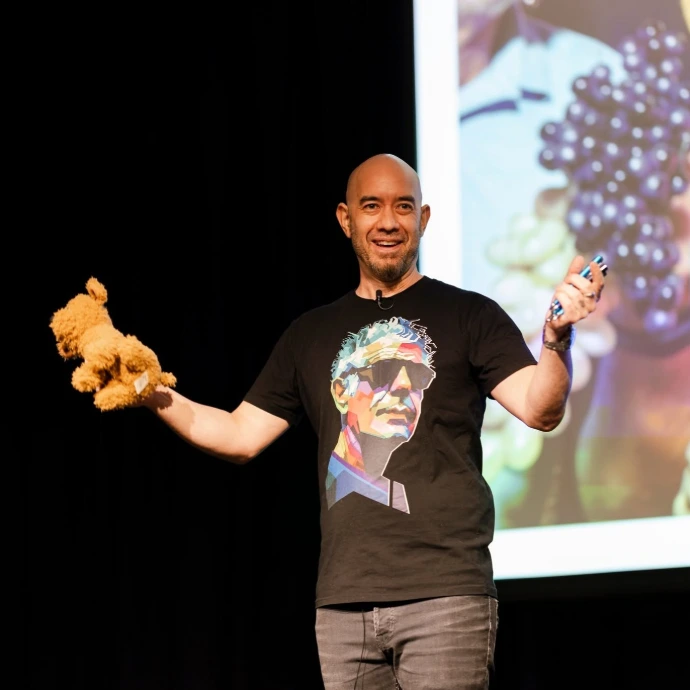
Christopher Phoenix
Phd Candidate
Wellbeing Facilitator at Phoenix Support for Educators.
Chris' dynamic keynote presentations have been described as 'hiding the vegies', as his important messages about helpful thinking, philosophy, and psychological wellbeing come with a twist of magic and a dash of hypnotic demonstration. Chris can deliver keynotes, workshop breakouts, panels, and MC.