
Pebbles, puddles and the possibilities of nature play
A commotion erupted along the bush kinder path.
‘Move back! It’s a leech!’ Evie announced, arms stretched wide like a pint-sized superhero, holding her friends at bay as they leaned in for a closer look at the alien-looking worm gliding over the pebbles.
‘It’s trying to cross the path. Let it through, it deserves to live!’ she added with conviction.
I blinked. Not the response I expected. And yet, somehow, not surprising at all.
When children are regularly immersed in nature, all of it, in all weather, and are guided by educators who model curiosity and care for Country, something beautiful happens. They begin to love their place, to feel custodianship for it, and to protect even the smallest of its creatures. As Dr Cindy Blackstock once said, ‘If children ruled the world, even the bugs would be taken care of.’
For seven years, every Tuesday (barring heatwaves and hailstorms), my colleagues and I would meet with 14 adventurous 3–5-year-olds deep in the National Parklands for bush kinder. No fences. Just (a few thousand acres of) Australian native bush, cliffs, creeks, critters, and the shared sense of wonder that comes from learning together in nature.
If that sounds a little wild, you wouldn’t be the first to think so.
But for these children, this was their backyard. Other educators I know take children into urban nature: navigating footpaths, traffic lights, and the occasional pigeon, which is equally wild in its own way. Context aside, educators across the country echo the same reflections:
In their words
‘Children play differently out there.’
‘It’s so freeing, for them and for us.’
‘They become so capable and resilient.’
‘Children who never play together at the centre play together at bush.’
‘It’s the best part of our week.’
And research agrees. Nature play boosts physical and mental health, supports resilience, creativity, social and language skills, and deepens children’s connection to the environment (Arola et al., 2023; Fyfe-Johnson et al., 2021; Hughes et al., 2021). In short, it’s good for the body, brain, and heart.
Or as Erin Kenny (2013) famously put it:
‘Children cannot bounce off the walls if we take away the walls.’
Erin Kenny
At its heart, nature pedagogy is about slowing down, connecting with and in nature. It’s an antidote to the rush of our modern lives. When we gift children time to explore, wonder, and even get bored, we also gift them autonomy, mastery, and the deep satisfaction of figuring things out for themselves.
And when we do that, magic happens.
Over my years at bush kinder, I’ve watched countless moments of that magic:
- Awe-filled faces as children notice the tiniest seasonal shifts.
- The sense of belonging as children named the places they loved: ‘the fairy tree’, ‘the skate park’, ‘the water park’ or ‘alien fungus’.
- Their growing ability to read Country: ‘Muyan (the silver wattle) is flowering, so dhandah (snakes) will be out soon.’
- Advocacy for nature, from collecting rubbish to petitioning for possum habitats and even contributing to parliamentary submissions to protect old-growth forests.
- And the data backed it up; the AEDC results showed significant decreases in vulnerability and increases in children classed as ‘on track’ across all domains over time.
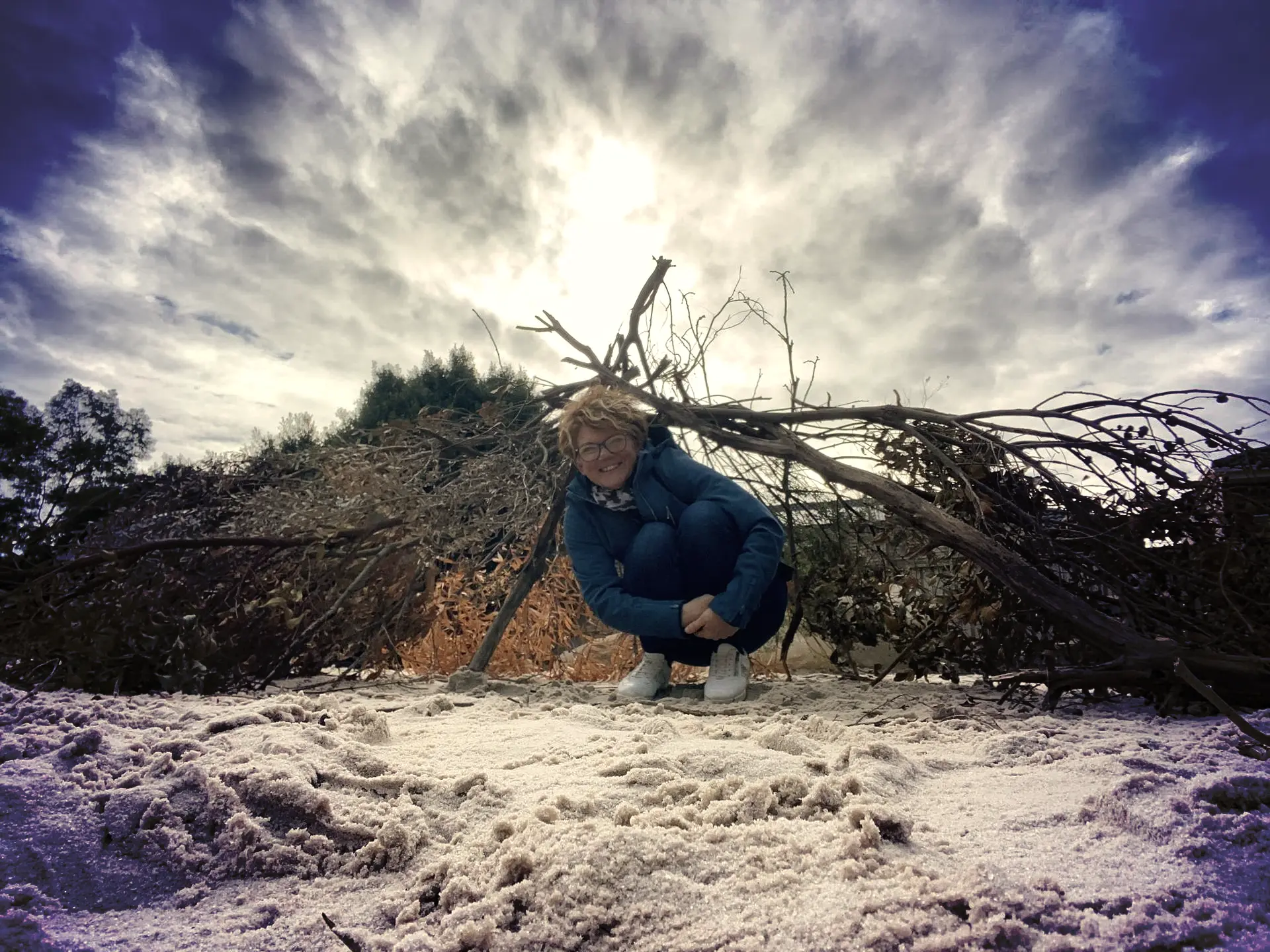
Over my years at bush kinder, I’ve watched countless moments of magic!
Linda Price, Education Facilitator and Mentor
Learning through nature: a living STEAM classroom
When I first began teaching bush kinder, I expected to see children’s resilience and creativity flourish; that much is well documented in the research. What I hadn’t anticipated, however, was how bush kinder would become a natural platform for embedding First Nations perspectives and rich STEAM learning.
The children and I began noticing seasonal changes in the environment, guided by the local Indigenous seasonal cycles, which became our calendar. We drew on these patterns to inform our program, learning directly from Country, such as when bracken fern fronds begin to shoot from the ground in their curled monkey tails, the stinging ants (bull ants, jumping jacks) become active again, so we were once again on the lookout for nest activity.
Incorporating First Nations languages into our everyday became far more authentic in this natural setting. Naming plants, animals, and landmarks in language felt meaningful and alive.
Our exploration of animal tracks and scat turned into a highlight of the program. Using field guides to identify ‘who’s been here’ became lessons in sorting, classifying, and managing data sets: the foundations of algebraic thinking long before anyone held a pencil.
Mathematics came alive in unexpected ways too. On our walks, children gathered gum leaves and compared their size, shape, colour, and texture, engaging in perceptual subitising, non-metric measurement, comparing, contrasting, and problem-solving.
Science and art often merged. Grinding sandstone into powder and adding water to create paint was trial-and-error in action: scientific thinking meeting creativity and expression.
And when we floated leaf boats down the rippling streams, children explored buoyancy, material density, geometry, velocity, and flow, all without a worksheet in sight.
Learning in nature, it turns out, is the curriculum: alive, sensory, connected, and deeply meaningful.
Nature play fills everyone’s Cups
Nature play nurtures children and restores educators, too. Out there, surrounded by fresh air instead of paperwork, time slows down. We breathe easier. We remember why we do this work.
Because in the end, the real joy, the reason we create these programs in the first place, is watching children fall in love with nature.
So when I saw Evie holding back her friends to protect a humble leech, I knew: my work here is done.
Introducing ‘Pebbles, Puddles and Possibilities’
If this story resonates with you, if you’ve ever seen a child’s eyes light up in the rain, or wished your team had more ways to support rich learning through nature play, then you’ll love our new workshop:
‘Pebbles, Puddles and Possibilities: supporting learning through nature play.’
This session dives into practical, research-informed ways to make the most of nature play balancing theory, safety, curiosity, and connection through hands-on learning. You’ll explore plenty of real-world examples of how to support children’s learning in natural settings, and discover how the simplest outdoor moments can become powerful opportunities for growth, wellbeing, and joy.
Because whether it’s a puddle, a pebble, or a patch of bush, nature holds infinite possibilities.
References
Arola, T., Aulake, M., Ott, A., Lindholm, M., Kouvonen, P., Virtanen, P., & Paloniemi, R. (2023). The impacts of nature connectedness on children’s well-being: Systematic literature review. Journal of Environmental Psychology, 85, Article 101913. https://doi.org/10.1016/j.jenvp.2022.101913
Fyfe-Johnson, A. L., Hazlehurst, M. F., Perrins, S. P., Bratman, G. N., Thomas, R., Garrett, K. A., Hafferty, K. R., Cullaz, T. M., Marcuse, E. K., & Tandon, P. S. (2021). Nature and children’s health: A systematic review. Pediatrics, 148(4), Article e2020049155. https://doi.org/10.1542/peds.2020-049155
Hughes, F., Elliott, S., Anderson, K., & Chancellor, B. (2021). Early years learning in Australian natural environments. Oxford University Press.
Kenny, E. K. (2013). Forest kindergartens: The Cedarsong Way. Cedarsong Nature School.
Further reading
Australian Institute of Family Studies. (2024). Nature play and child wellbeing. https://aifs.gov.au/resources/policy-and-practice-papers/nature-play-and-child-wellbeing
Burgess, E., & Ernst, J. (2020). Beyond traditional school readiness: How nature preschools help prepare children for academic success. The International Journal of Early Childhood Environmental Education, 7(2), 17–33.
Capaldi, C. A., Dopko, R. L., & Zelenski, J. M. (2014). The relationship between nature connectedness and happiness: A meta-analysis. Frontiers in Psychology, 5, Article 976. https://doi.org/10.3389/fpsyg.2014.00976
Pritchard, A., Richardson, M., Sheffield, D., & McEwan, K. (2020). The relationship between nature connectedness and eudaimonic well-being: A meta-analysis. Journal of Happiness Studies, 21, 1145–1167. https://doi.org/10.1007/s10902-019-00118-6
Richardson, M. (2025). Modelling nature connectedness within environmental systems: Human-nature relationships from 1800 to 2020 and beyond. Earth, 6(3), Article 82. https://doi.org/10.3390/earth6030082
Author: Linda Price
Pebbles, puddles and the possibilities of nature play
A commotion erupted along the bush kinder path.
‘Move back! It’s a leech!’ Evie announced, arms stretched wide like a pint-sized superhero, holding her friends at bay as they leaned in for a closer look at the alien-looking worm gliding over the pebbles.
‘It’s trying to cross the path. Let it through, it deserves to live!’ she added with conviction.
I blinked. Not the response I expected. And yet, somehow, not surprising at all.
When children are regularly immersed in nature, all of it, in all weather, and are guided by educators who model curiosity and care for Country, something beautiful happens. They begin to love their place, to feel custodianship for it, and to protect even the smallest of its creatures. As Dr Cindy Blackstock once said, ‘If children ruled the world, even the bugs would be taken care of.’
For seven years, every Tuesday (barring heatwaves and hailstorms), my colleagues and I would meet with 14 adventurous 3–5-year-olds deep in the National Parklands for bush kinder. No fences. Just (a few thousand acres of) Australian native bush, cliffs, creeks, critters, and the shared sense of wonder that comes from learning together in nature.
If that sounds a little wild, you wouldn’t be the first to think so.
But for these children, this was their backyard. Other educators I know take children into urban nature: navigating footpaths, traffic lights, and the occasional pigeon, which is equally wild in its own way. Context aside, educators across the country echo the same reflections:
In their words
‘Children play differently out there.’
‘It’s so freeing, for them and for us.’
‘They become so capable and resilient.’
‘Children who never play together at the centre play together at bush.’
‘It’s the best part of our week.’
And research agrees. Nature play boosts physical and mental health, supports resilience, creativity, social and language skills, and deepens children’s connection to the environment (Arola et al., 2023; Fyfe-Johnson et al., 2021; Hughes et al., 2021). In short, it’s good for the body, brain, and heart.
Or as Erin Kenny (2013) famously put it:
‘Children cannot bounce off the walls if we take away the walls.’
Erin Kenny
At its heart, nature pedagogy is about slowing down, connecting with and in nature. It’s an antidote to the rush of our modern lives. When we gift children time to explore, wonder, and even get bored, we also gift them autonomy, mastery, and the deep satisfaction of figuring things out for themselves.
And when we do that, magic happens.
Over my years at bush kinder, I’ve watched countless moments of that magic:
- Awe-filled faces as children notice the tiniest seasonal shifts.
- The sense of belonging as children named the places they loved: ‘the fairy tree’, ‘the skate park’, ‘the water park’ or ‘alien fungus’.
- Their growing ability to read Country: ‘Muyan (the silver wattle) is flowering, so dhandah (snakes) will be out soon.’
- Advocacy for nature, from collecting rubbish to petitioning for possum habitats and even contributing to parliamentary submissions to protect old-growth forests.
- And the data backed it up; the AEDC results showed significant decreases in vulnerability and increases in children classed as ‘on track’ across all domains over time.
Over my years at bush kinder, I’ve watched countless moments of magic!
Linda Price, Education Facilitator and Mentor
Learning through nature: a living STEAM classroom
When I first began teaching bush kinder, I expected to see children’s resilience and creativity flourish; that much is well documented in the research. What I hadn’t anticipated, however, was how bush kinder would become a natural platform for embedding First Nations perspectives and rich STEAM learning.
The children and I began noticing seasonal changes in the environment, guided by the local Indigenous seasonal cycles, which became our calendar. We drew on these patterns to inform our program, learning directly from Country, such as when bracken fern fronds begin to shoot from the ground in their curled monkey tails, the stinging ants (bull ants, jumping jacks) become active again, so we were once again on the lookout for nest activity.
Incorporating First Nations languages into our everyday became far more authentic in this natural setting. Naming plants, animals, and landmarks in language felt meaningful and alive.
Our exploration of animal tracks and scat turned into a highlight of the program. Using field guides to identify ‘who’s been here’ became lessons in sorting, classifying, and managing data sets: the foundations of algebraic thinking long before anyone held a pencil.
Mathematics came alive in unexpected ways too. On our walks, children gathered gum leaves and compared their size, shape, colour, and texture, engaging in perceptual subitising, non-metric measurement, comparing, contrasting, and problem-solving.
Science and art often merged. Grinding sandstone into powder and adding water to create paint was trial-and-error in action: scientific thinking meeting creativity and expression.
And when we floated leaf boats down the rippling streams, children explored buoyancy, material density, geometry, velocity, and flow, all without a worksheet in sight.
Learning in nature, it turns out, is the curriculum: alive, sensory, connected, and deeply meaningful.
Nature play fills everyone’s Cups
Nature play nurtures children and restores educators, too. Out there, surrounded by fresh air instead of paperwork, time slows down. We breathe easier. We remember why we do this work.
Because in the end, the real joy, the reason we create these programs in the first place, is watching children fall in love with nature.
So when I saw Evie holding back her friends to protect a humble leech, I knew: my work here is done.
Introducing ‘Pebbles, Puddles and Possibilities’
If this story resonates with you, if you’ve ever seen a child’s eyes light up in the rain, or wished your team had more ways to support rich learning through nature play, then you’ll love our new workshop:
‘Pebbles, Puddles and Possibilities: supporting learning through nature play.’
This session dives into practical, research-informed ways to make the most of nature play balancing theory, safety, curiosity, and connection through hands-on learning. You’ll explore plenty of real-world examples of how to support children’s learning in natural settings, and discover how the simplest outdoor moments can become powerful opportunities for growth, wellbeing, and joy.
Because whether it’s a puddle, a pebble, or a patch of bush, nature holds infinite possibilities.
References
Arola, T., Aulake, M., Ott, A., Lindholm, M., Kouvonen, P., Virtanen, P., & Paloniemi, R. (2023). The impacts of nature connectedness on children’s well-being: Systematic literature review. Journal of Environmental Psychology, 85, Article 101913. https://doi.org/10.1016/j.jenvp.2022.101913
Fyfe-Johnson, A. L., Hazlehurst, M. F., Perrins, S. P., Bratman, G. N., Thomas, R., Garrett, K. A., Hafferty, K. R., Cullaz, T. M., Marcuse, E. K., & Tandon, P. S. (2021). Nature and children’s health: A systematic review. Pediatrics, 148(4), Article e2020049155. https://doi.org/10.1542/peds.2020-049155
Hughes, F., Elliott, S., Anderson, K., & Chancellor, B. (2021). Early years learning in Australian natural environments. Oxford University Press.
Kenny, E. K. (2013). Forest kindergartens: The Cedarsong Way. Cedarsong Nature School.
Further reading
Australian Institute of Family Studies. (2024). Nature play and child wellbeing. https://aifs.gov.au/resources/policy-and-practice-papers/nature-play-and-child-wellbeing
Burgess, E., & Ernst, J. (2020). Beyond traditional school readiness: How nature preschools help prepare children for academic success. The International Journal of Early Childhood Environmental Education, 7(2), 17–33.
Capaldi, C. A., Dopko, R. L., & Zelenski, J. M. (2014). The relationship between nature connectedness and happiness: A meta-analysis. Frontiers in Psychology, 5, Article 976. https://doi.org/10.3389/fpsyg.2014.00976
Pritchard, A., Richardson, M., Sheffield, D., & McEwan, K. (2020). The relationship between nature connectedness and eudaimonic well-being: A meta-analysis. Journal of Happiness Studies, 21, 1145–1167. https://doi.org/10.1007/s10902-019-00118-6
Richardson, M. (2025). Modelling nature connectedness within environmental systems: Human-nature relationships from 1800 to 2020 and beyond. Earth, 6(3), Article 82. https://doi.org/10.3390/earth6030082
Author: Linda Price