
Risky Play
Last reviewed: August 2026
Risk-taking in play has many and varied benefits. In fact, risky play can even support children and young people's mental health. Through regular exposure to risk-taking from an early age, children and young people can learn to master their own skills, at a level that is appropriate for them as individuals (not based on their age). This builds dispositions of persistence, resilience, and problem-solving skills. Most importantly, it also builds risk competence. Risky/adventurous play may minimise anxiety in individuals as there is evidence through various studies that risky play can act as a type of antidote to anxiety.
A study found that children who had improved their motor skills in playgrounds at an early age were less likely to suffer accidents as they got older (Kambas et al., 2004). This is because risky play provides children with the opportunity to understand their own preferences and limits when it comes to risk taking and are equipped with a greater understanding of risk competence.
Put this resource into practice
Use our Embedding Practice With Intentionality tool alongside this QIP resource to support your team to move from reflection into purposeful action.
The tool provides a place to capture your starting point, identify your goal and practice priorities, connect with the NQS and relevant learning framework, and bring together the voices and noticings that inform your practice. As your thinking and practice evolve, you can return to the tool to capture emerging measures of success and consider what may be ready to transfer or reference within your QIP.
Download the Embedding Practice With Intentionality toolPut this resource into practice
Use our Embedding Practice With Intentionality tool alongside this QIP resource to support your team to move from reflection into purposeful action.
The tool provides a place to capture your starting point, identify your goal and practice priorities, connect with the NQS and relevant learning framework, and bring together the voices and noticings that inform your practice. As your thinking and practice evolve, you can return to the tool to capture emerging measures of success and consider what may be ready to transfer or reference within your QIP.
Download the Embedding Practice With Intentionality toolTo understand more about how to implement risky play within an early learning or school age care service, it is first important to understand the basics of what constitutes as risky play. These are commonly broken into 8 types of risky play:
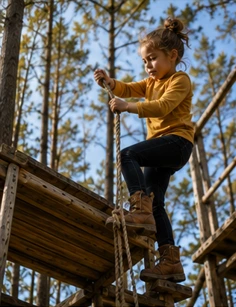
Great heights
Children and young people seek opportunities to climb to great heights and jump, balance, hang, or swing from those heights. Interacting with great heights helps children face fears and build confidence. Climbing to great heights comes with the risk of injury from falling.
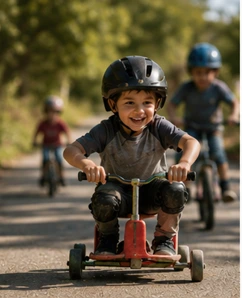
Rapid speeds
Individuals seek opportunities to run, swing, slide, sled, bicycle, skate, roll, ride, and spin at rapid speeds. Moving at rapid speeds helps children understand and use their bodies. Moving at rapid speeds can lead to injury from collision.
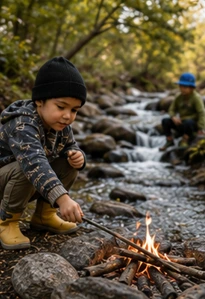
Dangerous Elements
Opportunities to engage with potentially dangerous elements such as fire or deep, cold, or moving water. Engaging with dangerous elements is a chance to face fears and understand the world. Engaging with dangerous elements can lead to injuries and wounds.

Impact
Children and young people enjoy the feeling of impact such as jumping off something, or bang-and-crash style play. It provides a thrilling feeling as well as proprioceptive information such as the feeling of the impact through their body. Engaging in impact play can lead to knocks and bumps.

Disappearing or getting lost
Children seek opportunities to play and explore unfamiliar spaces either alone or in small groups. Disappearing or getting lost offers a temporary scary thrill. Allowing children to play at disappearing or getting lost could result in a child actually getting lost.
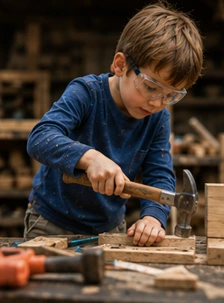
Dangerous Tools
Children and young people seek opportunities to use potentially dangerous tools like knives, saws, axes, rope, power tools, machinery, etc. Using dangerous tools helps children build confidence and skills. Using dangerous tools can lead to injuries and wounds.
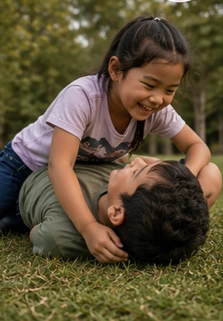
Rough and Tumble
Children and young people seek opportunities to play fight, wrestle, chase, sword fight with sticks or pool noodles, etc. Rough and tumble play is a chance to hone physical and social skills. It also helps children begin to understand personal boundaries, consent and rights to opt-out of chosen activities. Participating in rough and tumble play can lead to physical injuries like scratches and bruises.
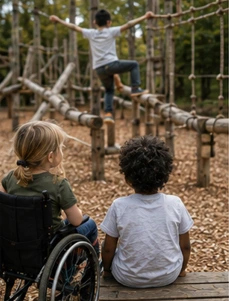
Vicarious risk
Individuals can gain the same internal sense of thrill (interoception feeling) of risk by observing others engaging in risky play activities. Sandsetter argues this is particularly relevant for very young children, though one could argue that it is relevant for all ages.
Goal
To develop educators' skills in supporting risky/adventurous play opportunities for children and young people.
To increase the risks or challenges available within both indoor and outdoor environments that scaffold learning and offer opportunities for appropriate risk taking and adventurous play.
To support children and young people to develop their risk competency and risk literacy skills through using risk-supportive language.
To shift from risk assessments to understanding risk-benefit analysis while assessing risky play activities.
To differentiate between risks versus hazards. It is important to make the distinction between what is a risk and what is a hazard. Having this knowledge will help educators to make consistent decisions around children's play and how to support it.
What informs this practice?
There are many benefits of adult supported adventurous play (risky play). Thrill-seeking play supports physical benefits like better dexterity, skeletal muscle development, and physical awareness (Fannin et al., 2024).
Vigorous activity that is inspired by thrill-seeking play enhances bone density in children and young people by about 5–10% when benchmarked at ages 5, 8, and 11 (Fannin et al., 2024).
Risk-taking in play can give children opportunities to:
- challenge themselves
- test limits
- overcome fear
- explore boundaries
- learn to fail and keep trying
Risk or Hazard?
A risk is a challenge or uncertainty that a child or young person can recognise in their environment and determine whether to engage with it or not.
Whereas a hazard is a danger in the environment that is beyond the child's understanding and can result in severe injury or endangerment. It is the adult's role to act in order to minimise or eliminate this hazard.
For example: A set of monkey bars to swing on, climb up on or hang off can be a risk which children can engage with at their own level of comfort. If the monkey bars are wet the water may cause a slip hazard. Adults can minimise this hazard by pointing the hazard out to individuals and using a towel to dry the rungs.
Or If children are climbing a tree, this is a risk they can engage in at their own level of comfort. If a branch in the tree is rotten, this is a hazard they may not be aware of that can cause harm (e.g. breaking when they stand on it). Adults can alert climbers to this hazard and engage in conversation on how to keep safe whilst climbing.
In a school age care context this might look like children or young people building and tending a fire pit for a group cook-up or using real tools in a carpentry space - same risk/hazard thinking, just scaled to older, more independent children.
Links to Frameworks
Keeping references current
Frameworks, legislation and guidance continue to evolve and may be reviewed or updated over time. And, as we know, sometimes they seem to update while we’re sleeping! When using these resources, we encourage educators and leaders to also refer to the relevant official source to ensure they are working with the most current information.
NATIONAL QUALITY STANDARDS
Element 2.1.2 – Health practices and procedures
Risk-benefit analysis, shared educator understanding of "risky" play, and confident professional judgement in supervision - rather than blanket risk elimination - is how injury management is genuinely embedded in everyday practice.
Element 3.2.1 – Inclusive environment
Environments resourced with graduated levels of challenge - climbing, balancing, tool use, natural features - directly reflect the "appropriate levels of challenge" this element calls for.
EYLF V2.0
Principles
Equity, inclusion and high expectations:
- A multi-modal, sensory-rich environment offers more than one way to participate, removing barriers for children with diverse sensory needs, including neurodivergent children.
Critical reflection and ongoing professional learning
- Educators actively building knowledge of the seven senses and reviewing their own environment against it is this principle in action.
Collaborative leadership and teamwork
- Team discussions to agree on safe limits for heavy-work equipment reflect shared, collaborative decision-making.
Practices
Holistic, integrated and interconnected approaches
- Sensory development connects physical, cognitive, and social-emotional domains - a holistic view of learning.
Responsiveness to children
- Encouraging children to self-select sensory experiences, rather than only at set times, is direct responsiveness to individual cues and needs.
Play-based learning and intentionality
- Intentional heavy-work resourcing and purposeful use of music and rhythm show deliberate educator decisions within play-based experiences.
Learning environments
to provide environments that invite open-ended play, physically active play and games, spontaneity, risk-taking, exploration, discovery and connection with nature (EYLF v2.0, p.23).
- A program built deliberately around the 8 types of risky play is this practice in direct action.
Outcomes
Outcome 1 – Strong sense of identity (p.23, p.34):
- Children develop autonomy, resilience and agency when they take considered risk in decision-making - exactly what risk-supportive language and risk-versus-hazard understanding builds.
Outcome 3 – Strong sense of wellbeing (p.45, p.47):
- Considered risk-taking, challenge, and coping with the unexpected build the social, emotional, physical and mental wellbeing this outcome describes.
Outcome 4 – Confident and involved learners (p.53):
- Planning flexible environments with appropriate challenge, where children are encouraged to explore, experiment and take appropriate risks, is the core design principle behind this program.
MTOP V2.0
Principles
Equity, inclusion and high expectations:
- A multi-modal, sensory-rich environment offers more than one way to participate, removing barriers for children with diverse sensory needs, including neurodivergent children.
Critical reflection and ongoing professional learning
- Educators actively building knowledge of the seven senses and reviewing their own environment against it is this principle in action.
Collaborative leadership and teamwork
- Team discussions to agree on safe limits for heavy-work equipment reflect shared, collaborative decision-making.
Practices
Holistic, integrated and interconnected approaches
- Sensory development connects physical, cognitive, and social-emotional domains - a holistic view of learning.
Responsiveness to children
- Encouraging children to self-select sensory experiences, rather than only at set times, is direct responsiveness to individual cues and needs.
Play-based learning and intentionality
- Intentional heavy-work resourcing and purposeful use of music and rhythm show deliberate educator decisions within play-based experiences.
Learning environments
to provide environments that invite open-ended play, physically active play and games, spontaneity, risk-taking, exploration, discovery and connection with nature (EYLF v2.0, p.23).
- A program built deliberately around the 8 types of risky play is this practice in direct action.
Outcomes
Outcome 1 – Strong sense of identity (p.23, p.34):
- Children develop autonomy, resilience and agency when they take considered risk in decision-making - exactly what risk-supportive language and risk-versus-hazard understanding builds.
Outcome 3 – Strong sense of wellbeing (p.45, p.47):
- Considered risk-taking, challenge, and coping with the unexpected build the social, emotional, physical and mental wellbeing this outcome describes.
Outcome 4 – Confident and involved learners (p.53):
- Planning flexible environments with appropriate challenge, where children are encouraged to explore, experiment and take appropriate risks, is the core design principle behind this program.
Planning Cycle
Plan and Design (p.31):
- Considering the benefits of risk and challenge at the planning stage is the risk-benefit approach this program embeds from the outset.
VEYLDF
Principles
High Expectations for every child (p.10):
- Holding high expectations for children's risk-taking capability - rather than assuming incapacity = is this protective factor in practice.
Outcomes
Outcome 3 – Strong sense of wellbeing (p.20):
- Outdoor play that builds children's ability to assess risk is precisely what this program's outdoor risky play opportunities provide.
Outcome 4 – Confident and involved learners (p.21):
- Framing failure as a valuable, expected part of risk-taking builds the comfort with risk and mistake-recovery this outcome describes.
QLKG
Intentional teaching strategies (p.15):
- Deliberately choosing when to step back, when to intervene, and when to use risk-supportive language is this intentional, purposeful decision-making in practice.
Identity (p.24):
- Reflecting on what helps children feel secure enough to take risks and try new experiences is a direct application of this learning area.
Wellbeing (p.38):
- Practising safe choice-making around risk, and developing awareness of safe versus unsafe risks, is this significant learning realised through everyday risky play.
Recommendations (Steps to Achieve the Goal)
As the Play Australia National Statement on Risky Play (2025) advocates, risky play should and can be promoted in all spaces and places, including privately-owned and public spaces, built and natural environments, including schools and early childhood education settings (p.13). Instead of trying to eliminate all risk from play, understand that risky play can be acceptable where the benefit to children's learning outweighs the risks.
Risk Benefit Analysis
The traditional risk assessment is rapidly being updated to a 'risk benefit analysis' which helps educators to assess the risk of an activity alongside its benefits. This language is reflected in the Guide to the National Quality Framework (2025) and also echoed in the Play Australia National Statement on Risky Play 2025 (p.13).
"The current prioritising of risk over benefit is no longer tenable and a shift towards a benefit-risk narrative reflecting contemporary research evidence is essential. This requires reframing risk both for and with children and adults, acknowledging children's inherent risky play dispositions and positively promoting wider access to risky play utilising a benefit-risk analysis approach." (Play Australia National Statement on Risky Play 2025, p.13)
"Instead of trying to eliminate all risk from children's play, it is important to understand that risky play can be acceptable where the benefit to children's learning outweighs the risks." (Guide to the National Quality Standard, p.174)
Gaining children and young people's voices and thoughts on how to manage risks is crucial and puts them central to service governance. Download our template from the toolkit below and get started on your own risk benefit analysis referencing information about child development, core strength, vestibular development, proprioception, upper body strength, cross meridian movement, confidence building and resilience.
Developing Risk Competence and Risk-Supportive Language
The development of a solid approach to adult supported adventurous play includes the language we use to discuss risk and adventure with children and young people.
When we tell children to "be careful" or "you'll hurt yourself," we often have the best intentions, to protect them. Yet, what children might actually hear is that they aren't capable and that the world is unsafe. Over time, these messages can chip away at their sense of competence and confidence to explore within their zone of proximal development.
What to Say Instead of "Be Careful!"
In order for children and young people to engage safely in adventurous play experiences we can teach them critical thinking around safety and risk by using problem solving language. Next time you feel a "be careful" bubbling up, try one of these phrases:
- Notice how… the bars are wet, the rocks are wobbly, that branch is rotten?
- Can I give you some information…? Rain makes the balancing logs slippery.
- How are you feeling? In your tummy? In your mind?
- Try using your… hand, foot, legs, arms.
- Did you see… the stinging nettle, your friend nearby, the ant nest?
- What's your plan... if you climb that tree, if you can't reach that branch, if you go up too high?
- How will you… get down, reach across, get up, ensure you don't get burnt?
- What can you use… to bridge the gap, to make it safer, to keep others from being hurt?
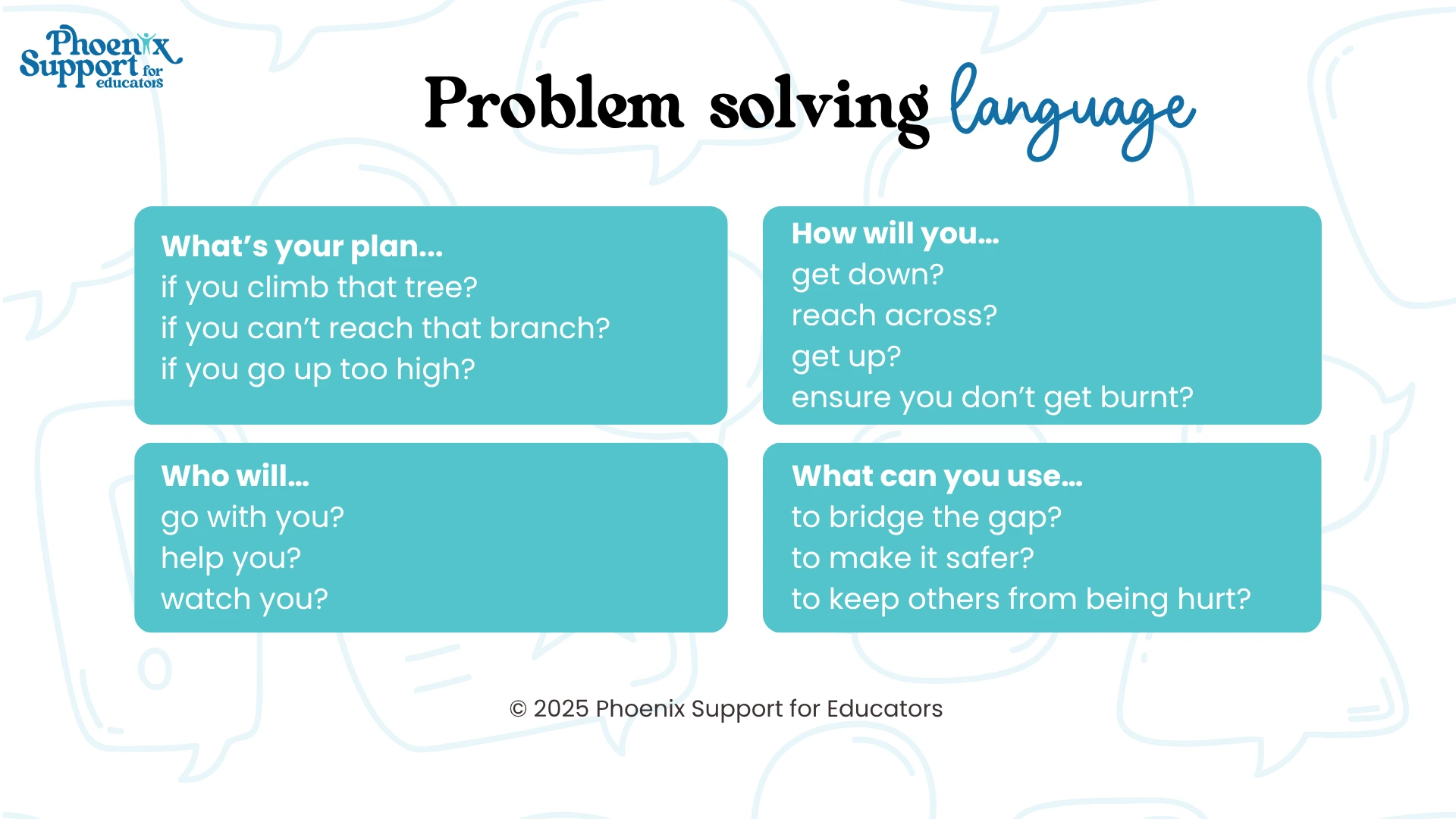
Image source: Phoenix Support for Educators, Playing with Risk Workshop
Another great strategy is 'say what you see and ask a question', which guides individual's learning whilst retaining positive relationships with educators:
- "Wow, you're climbing super high in the tree. What's your plan for getting down?"
- "That saw looks super sharp. How are you going to use it safely?"
- "I can see you want to jump off that big box, but there is a bike on the ground nearby. What do we need to do first to make it safe to jump?"
Considerations for School Age Care
As children move into school age care, educators' role shifts from close guidance toward genuinely trusting children with autonomy. MTOP v2.0 identifies "trust and support older children and young people to be autonomous and capable" as a specific educator practice (MTOP v2.0, p.37). In a risky play context, this might mean stepping back further than they would for younger children, allowing children to set their own boundaries around tool use, campfires, or bike riding, and resisting the urge to intervene at the same threshold used in the early years setting.
This also means auditing environments specifically for older children's needs. MTOP v2.0 notes that children in school age care "undertake more complex physical activities that allow risk-taking, particularly in the outdoor environment" (MTOP v2.0, p.47) and therefore services should check whether their spaces and equipment are genuinely scaled to this complexity, rather than relying on equipment designed for a younger cohort, which is common where school age care shares a site with a long day care service or primary school.
Risk-supportive language may also need adapting for some children. MTOP v2.0 notes that educators "adopt trauma-informed practices to enhance the safety and wellbeing of children and young people who have developmental trauma or who have experienced adversity" (MTOP v2.0, p.47). Educators working with school age children who are more likely to have a known or disclosed trauma history than very young children should hold the "notice how..." and "what's your plan..." style prompts alongside this awareness, adjusting tone and pacing where needed rather than applying them uniformly across every child.
Toolkit
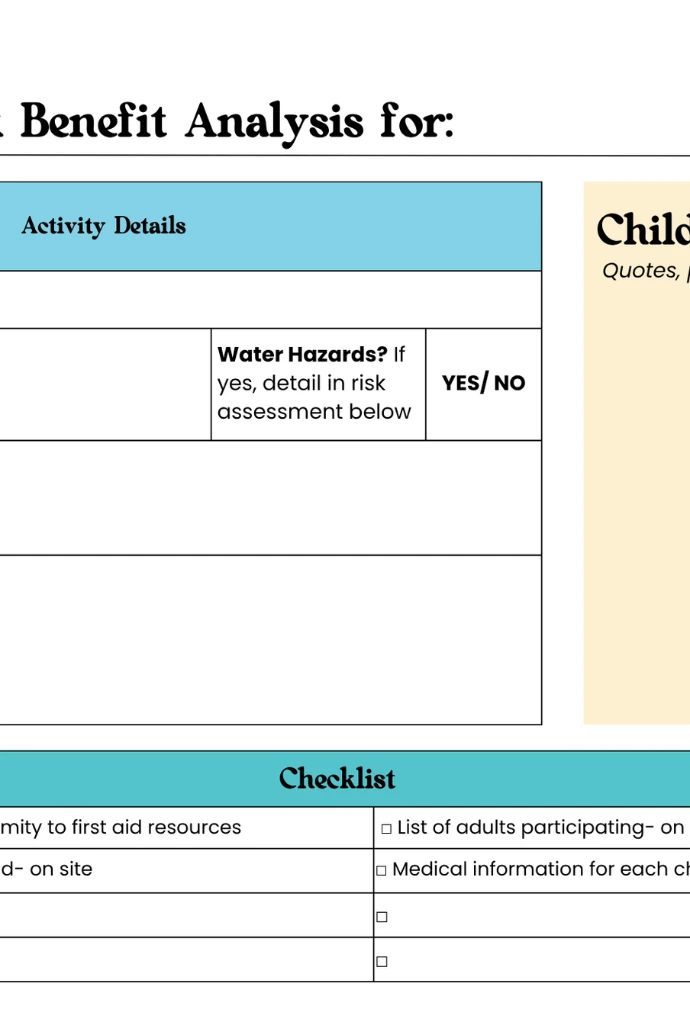
Risk-Benefit Analysis Template
A ready-to-use template for weighing the benefits of a new sensory or heavy-work experience against its hazards, with a likelihood-by-consequence risk matrix built in. Covers activity details, educator ratios, hazard identification, control measures, and review sign-off - everything the "complete a risk–benefit assessment" recommendation above requires, without starting from a blank page.
Reflective Questions
- How might our own experiences with risky play as a child influence our beliefs about risky play in early childhood?
- How do our educators feel about risky play? Excited? Nervous? Unsure?
- Can we use the eight categories of risky play to understand a starting point for implementing our approach to risky play?
- How do our families feel about risky play? Do they naturally support their children in risky play at home? (e.g. climbing trees, bike riding, campfires etc.)
- If we called risky play 'adult supported adventurous play' would that help our educators and families to embrace it better?
- What additional training might the team need to better understand and implement risky/adventurous play?
- What adventurous play experiences might be available for ALL children - including very young children?
- What additional resources might we need to support risky play? E.g. crash mats, carpentry bench, tools etc.
- What risky play experiences can be implemented immediately, mid-term and long term?
- What can families provide? E.g. is there a builder who can create a carpentry table? Can families donate old sheer curtains for cubby building?
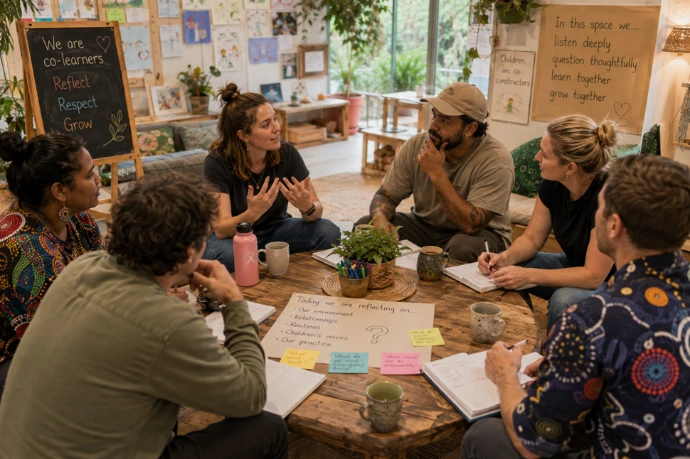
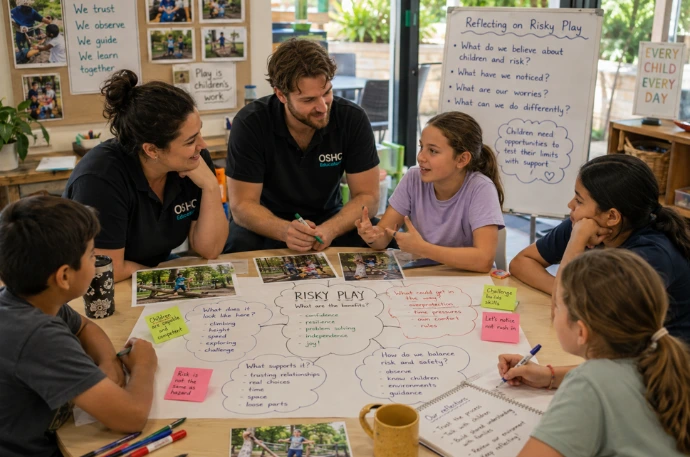
Reflecting on Risky Play in a School Age Care Context
- Are we offering children and young people real choice after a long day of being directed at school?
- Where do we sit on the continuum between "risk averse" and "developmentally supportive challenge", and what shaped that stance?
- What is a hazard we should remove, versus a risk we can support children and young people to navigate?
- How does "after-school depletion" show up in children and young people's bodies and behaviour, and how might that change the way we scaffold risky play?
- When children and young people push limits, are we reading it as defiance, or as a need for autonomy, competence, sensory input, or connection?
- Do we allow children and young people to test themselves gradually, or do we only intervene once it's escalated?
- How do older children and young people influence the culture of risky play? Do they mentor, lead, exclude, or dominate?
- Are older children given genuine autonomy over some of their own choices, or only within adult-set limits dressed up as choice?
- Are younger children included in challenging play safely, or shut out "for safety" without alternatives that meet the same needs?
Emerging measures of success
All educators feel better informed about risky/adventurous play and the benefits to children.
An agreed approach to implementing risky/adventurous play has been formulated, including a timeline.
Resources needed to support risky/adventurous play have been identified, sourced or planned for.
All children within the service have regular access to risky play experiences every day.
Observable evidence of risk-supportive language, risk-benefit thinking, and children's independent risk management is visible in daily practice and documentation.
Links
Risky Play: Part One | Phoenix Support For Educators
Risky Play: Part Two | Phoenix Support For Educators
Pebbles, puddles, and the possibilities of nature play
Barefoot isn't just for Babies | Phoenix Support For Educators
Reclaiming Play | Phoenix Support For Educators
Play Australia: National Risk Position Statement
Risky play for children and mental health benefits | Be You
Why Germany is building risk into its playgrounds | The Guardian The Land (documentary)
Risky play: why children love it and need it | Psychology Today Teacher Tom blog — safety play and rough play: http://teachertomsblog.blogspot.com/2015/11/safety-play.html http://teachertomsblog.blogspot.com/2021/08/is-it-risky-play-or-safety-play.html https://teachertomsblog.blogspot.com/2016/06/the-inherent-risk-of-risky-play.html https://earlyyearsoutdooreducation.wordpress.com/outdoor-risky-play-for-all/ Challenging Play - Risky | Kidsafe NSW ABC Does (Alistair Bryce Clegg) — blog on risky play and rough play benefits, including a policy template: https://abcdoes.com/ First Five Years: Risky play — why it benefits children First Five Years: Adventurous play — why children need risk ACECQA: Talking about practice — Adventurous play, developing a culture of risky play (PDF) The Unspoken Words of Risky Play | Child & Nature Alliance When you want to say "be careful" | Child & Nature Alliance
References
Dodd H.F., Lester K.J. (2021). Adventurous Play as a Mechanism for Reducing Risk for Childhood Anxiety: A Conceptual Model. Clin Child Fam Psychol Rev, 24(1), 164–181. https://pubmed.ncbi.nlm.nih.gov/33464448/
Dodd, H.F., Nesbit, R.J., FitzGibbon, L. (2023). Child's play: examining the association between time spent playing and child mental health. Child Psychiatry Hum Dev, 54, 1678–86. https://doi.org/10.1007/s10578-022-01363-2
Eager, D., Little, H. Risk Deficit Disorder. https://www.researchgate.net/publication/266172540_RISK_DEFICIT_DISORDER
Fannin, L.D., Thayer, Z.M., Dominy, N.J. (2024). Commemorating the monkey bars, catalyst of debate at the intersection of human evolutionary biology and public health. Evolution, Medicine, and Public Health, 12(1), 143–155. https://doi.org/10.1093/emph/eoae017
Gray, P. (2011). The Decline of Play and the Rise of Psychopathology in Children and Adolescents. American Journal of Play, 3(4), 443–463. https://files.eric.ed.gov/fulltext/EJ985541.pdf
Kambas, A., Panagiotis, A., Xanthi, G., Heikenfeld, R., Taxildaris, K. & Godolias, G. (2004). Accident prevention through development of coordination in kindergarten children. Deutsche Zeitschrift für Sportmedizin, 55, 44–47.
Jones, R.A., Little, H., Elliott, S., Tonge, K. (2025). A Risky Play Position Statement for Young Australian Children. Play Australia.
Risky Play
PDF DOWNLOAD COMING SOON