About
Playing with Intentionality supports educators to rethink what intentionality means within contemporary play-based practice. Rather than positioning intentional teaching as directive or adult-driven, this workshop explores intentionality as something that lives inside relationships, moment-to-moment decision-making, and responsive engagement with children’s play.
Drawing on current neuroscience and research into brain development, the workshop examines how play creates fertile ground for the development of executive function, including working memory, cognitive flexibility and inhibitory control. Educators are invited to consider how their presence, timing, language and interactions can strengthen these capacities without disrupting the integrity of play.
This session offers a rich foundation for understanding play as the central driver of children’s wellbeing, learning and development. Through professional dialogue, critical reflection and evidence-informed content, participants are supported to deepen, challenge and refine their existing practice, with a strong focus on the cognitive and emotional processes that underpin learning through play.
We will
- Explore how the concept of intentionality has evolved within EYLF v2.0, and what this shift means for everyday practice in play-based settings.
- Reflect on the distinction between teaching intentionally and playing with intentionality, with attention to how environments, relationships and educator choices shape learning experiences.
- Develop a shared understanding of executive function, how it emerges through play, and the ways responsive interactions and thoughtfully designed experiences support children’s cognitive growth.


Participant Outcomes
By the end of this workshop, participants will:
- have greater clarity and confidence in their practice, with the capacity to turn intention into meaningful, brain-aligned and heart-centred interactions that support children to learn, connect and thrive.
- feel confident explaining how intentionality has evolved in the EYLF v2.0, and articulating the difference between teaching intentionally and playing with intentionality in everyday practice.
- feel equipped to design and refine learning environments that invite critical thinking, problem-solving and rich social connection through play.
- have confidence to scaffold children’s learning through reflection, modelling and guided discovery, without interrupting the flow or purpose of play.
- deepen their understanding of executive function, including how play strengthens working memory, self-regulation and cognitive flexibility, and why these skills matter for lifelong learning and wellbeing.
"Intentional teaching vs playing with intentionality"
- Briana Thorne, Facilitator with Phoenix Support for Educators
Theoretical underpinnings
Phoenix Cups Framework
Sandi & Chris Phoenix
Behaviour is a child’s best attempt at meeting their needs. Children’s basic human life needs consistently influence their emotional state, wellbeing and behaviour. Educators responses can support regulation, wellbeing and readiness to learn.
Theory of Constructed Emotion
Dr Lisa Feldman-Barret
Educators explore how the brain continuously constructs meaning and emotion based on experience and context, and how play serves as the ideal platform for this development.
Self-Determination Theory
Ryan & Deci
Children thrive when their core psychological needs are met. Children’s wellbeing grows when environments actively support autonomy, competence, and relatedness as the foundations of children’s capacity to learn, relate, and regulate.

National Alignments
QA1: Educational Program and Practice, as you strengthen intentional decision-making and thoughtful curriculum design.
QA5: Relationships with Children, as you learn how to support responsive interactions that honour children’s agency and wellbeing.
QA7: Governance and Leadership, as you build reflective practice and professional capability across the team.
Standard 1.2 Know learners and how they learn: strengthening teacher understanding of children’s developmental needs, agency, and the role of intentionality in supporting wellbeing and engagement.
Standard 3.2 Plan for and implement effective teaching and learning: building capability in purposeful planning, responsive interactions, and designing rich, language-filled play environments.
Standard 6.2 Engage in professional learning: supporting reflective practice and ongoing growth, helping educators apply contemporary pedagogy with confidence.
Principle 1 – Child safety and wellbeing are embedded in organisational leadership, governance and culture. The course promotes a culture where children’s emotional safety, cognitive needs, and wellbeing guide every intentional teaching decision.
Principle 3 – Children are involved in decisions affecting them and are taken seriously. The course supports child-led play and agency, ensuring children’s ideas, choices, and perspectives shape learning experiences.
Principle 4 – Families and communities are informed and involved in promoting child safety and wellbeing. The course equips educators to communicate the benefits of intentional, play-based learning with families, strengthening shared responsibility.
Principle 5 – Equity is upheld and diverse needs are taken into account. The course positions intentional play as an inclusive, strengths-based approach where every child can access and succeed in developing executive function skills.
Social & Emotional Skills
- Equipping educators to create environments that bolster confidence, self-regulation, and wellbeing.
- Supporting educators to embed co-regulation, empathy, and emotional literacy within daily interactions. Barrett’s research demonstrates that emotional competence develops through experience and attuned social contexts rather than direct teaching.
- Educators learn to create emotionally safe spaces where children can label and manage their feelings through language, modelling, and connection.
Oral Language & Communication
- Children use language to negotiate, imagine, and problem-solve to naturally build vocabulary, narrative thinking, and comprehension.
- Educators learn how intentional dialogue, open-ended questioning, and the use of emotional language strengthen both linguistic skill and cognitive flexibility.
Executive function
- Supporting children to develop working memory, cognitive flexibility, and the foundations of self-control through thoughtfully designed play experiences.
- Understand how purposeful, play-based experiences strengthen brain systems responsible for working memory, cognitive flexibility, and self-regulation.
Communication (language, literacy and numeracy)
- Enhances children’s communication, language, and early literacy outcomes through intentional strategies for rich, language-filled interactions during play.
- Discussion, storytelling, and guided reflection, supports verbal exchanges in play such as negotiating rules, imagining roles, or narrating experiences build vocabulary, phonological awareness, and expressive language.
Wellbeing (social, emotional and executive function)
- Design playful, intentional experiences that scaffold children’s executive functioning, emotional regulation, and resilience.
- Explores how play builds neural pathways for executive function; such as working memory, cognitive flexibility, attention, and impulse control which are essential to children’s emotional stability and mental flexibility.
Access, Inclusion and Participation.
- Fosters equitable, inclusive teaching practices that engage all learners through play.
- Strategies are intentionally adaptable across diverse service contexts and inclusive of all children, recognising and responding to developmental, cultural, and linguistic diversity.
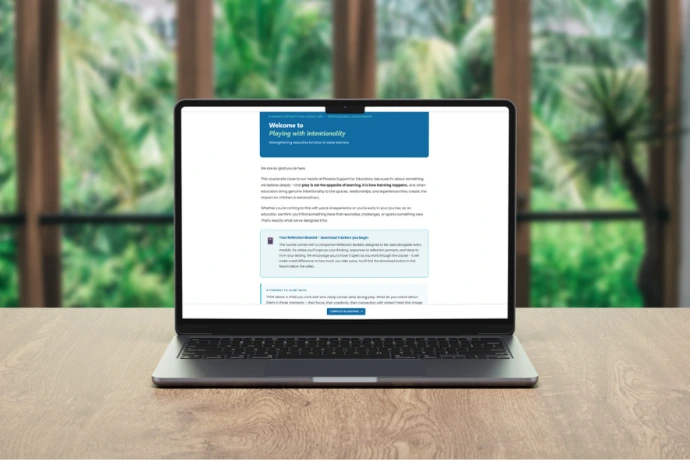
Online Course Option
Prefer to engage in this training from the comfort of your own home? We get it!
That's why we created the self-paced online course, with video content and downloadable workbooks.
More on intentionality
Interested in reframing intentionality? You can read all about it in our blog.
Book this workshop
Bring your team together to reflect, rethink, and re-energise your approach to intentionality in practice.