
Taking the fun cup seriously
A Day of Fun Cup filling (and why we need to plan for it!)
Here’s the thing about children and young people: they are born scientists, comedians, and explorers wrapped into one delightful little package. For instance, a toddler who discovers that wearing a colander on his head could transform him into a robot superhero. Cue the collective laughter, and everyone's immediate initiation into the Colander-On-The-Head Club. These moments aren’t just enjoyable; they are opportunities for learning and connection. Research backs this up! Fun is actually a genetic reward for learning, stimulating their brains while keeping stress levels low. (Panksepp, 2007).
As an early years educator, I've witnessed firsthand the pure magic that occurs when children are given the freedom to play, laugh, and follow their natural curiosities. Every person, adult, child and every stage in between have behaviours that are driven by our needs to get our basic human life needs met. This is the cornerstone of the Phoenix Cups Framework. These are our needs for Safety, Connection, Freedom, Mastery and Fun.
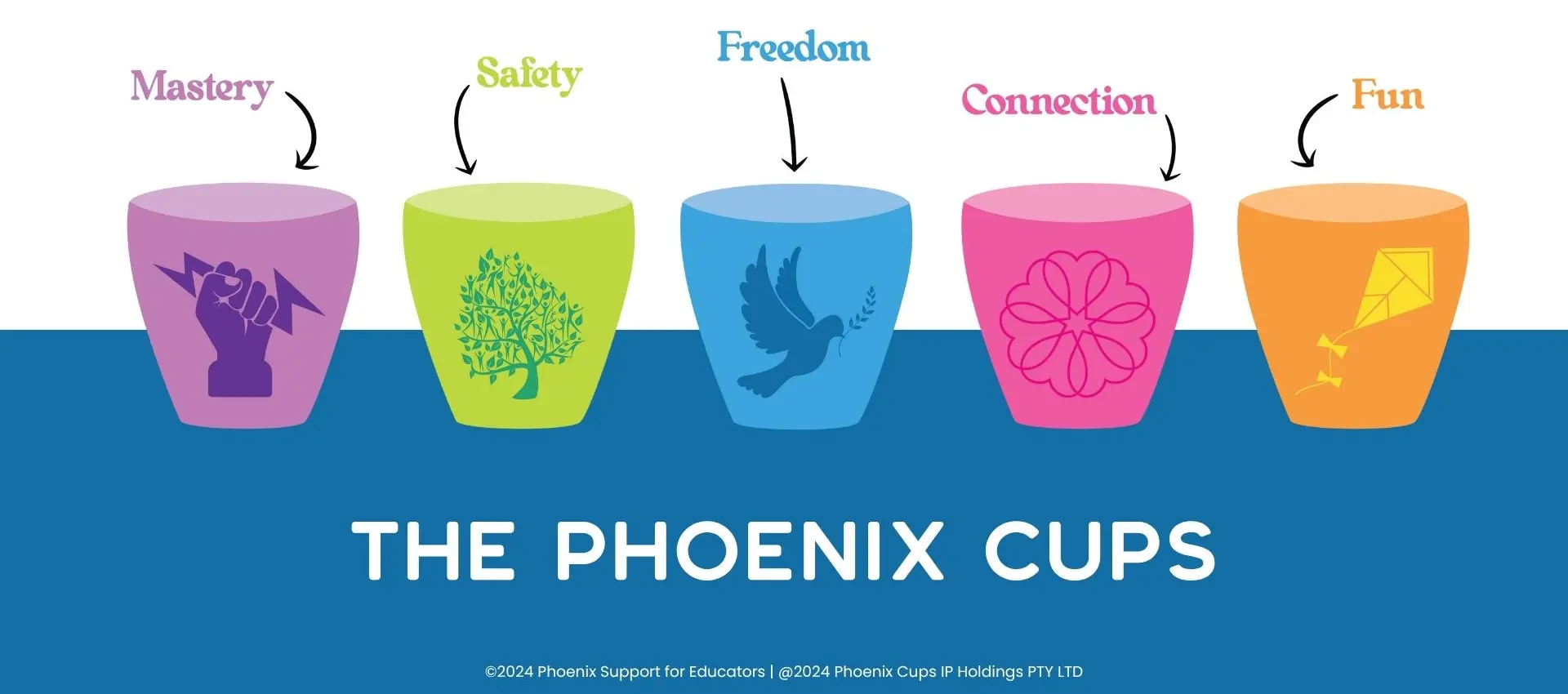
As adults, the world teaches us that our need for fun is optional. That we can focus on meeting all of our other needs, then maybe if we have enough time, then we can focus on fun...
This is a trap!
Children know this. Children know that fun is a Basic. Human. Life. Need.
I want to give you an example of how children’s need for fun and joy can impact so many parts of their day, their wellbeing and their learning if only we allow this to happen. You will note at many points where it would be so simple for adults to step in, control the fun and stop the behaviours. But bear with me and watch what can happen if only we let it!
A Day in the Life of Play
After morning arrival the educators start encouraging play and children’s engagement in their beautifully planned and presented tabletop experiences focusing on fine motor skills and based on children’s interests (dinosaur eggs!). Suddenly a child interrupts and asks for music. Educators happily put on some music and before you know it, we have a spontaneous dance party. Random songs send everyone hopping like kangaroos, crawling like crabs, and giggling hysterically. You would be forgiven for thinking they are just being silly, but looking closer they are regulating their emotions, building social connections, enhancing their physical fitness and overall health, developing gross motor skills and expressing themselves.
Soon after the children disperse and start the scheduled ‘free play’ time. During this time, you will find little architects crafting intricate marble runs or engineers obsessively joining (and disassembling) train tracks. This is their connecting schema at work, a way of learning through trial, error, and imagination. In the corner, another child wraps crayons in masking tape around and around and around. That’s their enveloping schema, and they are learning about capacity, boundaries, and space all while we marvel at their creativeness. (Atherton & Nutbrown, 2016)
Lunchtime comes and as children become hungry they head over to the cafe style lunch table. As they serve themselves children start to question, laugh and giggle. "Do peas bounce?" asks one child, letting loose an experimental roll off their plate. Answer: yes, and they roll quite well! A lively chat ensues about other bouncy foods (Jelly! Meatballs!) and how gravity works. This isn’t just playful chaos. It is science in action!
Outdoors with full bellies, someone starts a game of pirates. There are wild sea battles (sticks make convincing swords), daring jumps off the climbing frame (trajectory schema, anyone?), rough and tumble play as they wrestle giant squid and negotiations over who gets to captain the ship. By the end, everyone is too exhausted to mutiny, and their Fun Cups are positively overflowing.

How We Fill the Fun Cup
Filling children’s Fun Cups isn’t complicated, but it does require a good dose of energy, spontaneity, and, yes, trust. Trust to let children lead their play, to risk the occasional mess, and to understand that joy is a critical part of their growth.
Strategies we can use:
- Inject humour: Tell terrible jokes or share playful surprises. Wear a (hopefully clean) nappy on your head for nappy changes, wear odd socks, start randomly talking in a silly voice. See what happens!
- Create opportunities for choice: Whether it’s which puzzle to solve or which hat to wear in pretend play, autonomy brings extra joy.
- Celebrate moments big and small: Got a child who built a block tower taller than themselves? How about a child that tried something new even though they were nervous? That is a cause for a celebration. Share in achievements, have impromptu parties and be an equal partner in their joy.
What happens when we don’t prioritise fun? Children’s development can be impacted, and they miss out on crucial opportunities to build creativity, resilience, and social skills. Play deprivation, as experts call it, is not just a missed opportunity; it can have serious implications for their emotional and cognitive growth.
So, take a deep breath, educators and parents, and remember it is okay to lean into the chaos of fun. Yes, it might mean fingerprints on the walls and glitter in the carpet (I have surrendered many entire carpets to glitter), but it also means full hearts and inspired minds.
The Magic of Flow
One of my favourite ideas is ‘flow’ (Csikszentmihalyi, 2008) - those golden moments when children are so deeply engaged in play that they lose track of time. You’ll notice it in their laser focus as they pour sand into buckets or balance blocks in a gravity-defying structure. Our role is the simplest thing ever. To give children the time, space, and freedom to keep going. Flow is where learning and joy converge beautifully.
Working with young children is the perfect excuse to embrace play, laughter, and the unexpected. They remind us every day to approach life with curiosity, find humour in the smallest things, and fill our Fun Cups as much as theirs. Children’s joy is wonderfully infectious. In my favourite days working with children, it was always the ones where my laughter lines etched that little bit deeper into my face, where I have laughed played and embraced the silly chaos alongside the children.
So, let’s keep the Fun Cup at the forefront of our practice. Not just for the children but for us, too. After all, who said joy stops being important once you grow up?
Cheers to more laughter, glitter, and glorious adventures!
References
Atherton, F., & Nutbrown, C. (2016). Schematic pedagogy: supporting one child’s learning at home and in a group. International Journal of Early Years Education, 24(1), 63–79. https://doi.org/10.1080/09669760.2015.1119671
Csikszentmihalyi, M. (2008). Flow: The psychology of optimal experience. Harper Perennial.
Panksepp, J. (2007). Can play diminish ADHD and facilitate the construction of the social brain? American Journal of Play, 1(1), 39–57.
Author: Briana Thorne