Designing with the Elements / Working in Harmony with the Heat
A national reflection for Australian educators, with gratitude to our Territory colleagues for showing us what’s possible.
Written by Annette Johnson
“Rather than seeing summer as something to endure or avoid, Indigenous seasonal knowledge invites us to read the land differently and take our cues appropriately”
Across Australia, educators are familiar with the dance between indoor and outdoor learning, adjusting practice in response to weather, children and young people, and the rhythm of the day. We read the sky, listen to families, watch children’s energy, and make hundreds of small decisions that shape how a day unfolds.
This article is the first in a short series exploring all-weather play on Country, with a focus on what it looks like to design with the elements rather than retreat from them. Each reflection will focus on a different climate experience across Australia.
In this edition we’re focusing in on the heat. Queensland’s big, bold, unrelenting heat that often calls the shots. Every summer, the same refrain echoes through early childhood education care and school age care services across the state: “It’s too hot to go outside.”
It’s a well-meaning response, grounded in care and concern for children’s safety. And yet, in practice, this often means that from October through March, children and young people spend much of their day indoors. They miss out on opportunities to move their bodies, feeling fresh air, soaking up natural light, and being in relationship with the world beyond the walls, including meaningful connection to Country. These everyday experiences play an important role in children’s wellbeing, self-regulation, learning and mental health (Early Childhood Australia, 2022; Alla, 2023; Rhodes, 2023).
When limited outdoor time becomes routine, the impact is felt beyond the program itself. Its demonstrated in children’s bodies and behaviours. There are fewer opportunities to choose how and where to move, less space to explore, challenge themselves, and feel capable. Fewer moments of joy, collaboration, and calm.
Over time, children and young people begin to miss out on experiences that meet their most basic human needs. The need to move, to choose, to connect, to feel safe, and to grow in competence through experience (Pereira et al., 2024). On the flipside, when we work within the elements to provide environments that support those needs, children and young people flourish both in their play and also through opportunities for self-regulation, learning, belonging, and confidence (Ryan & Deci, 2017).
Insights into how to work with the natural elements to build environments where all humans can thrive come when we start working with Country, taking cues to inform our practice and pedagogy. For more than 65,000 years, First Nations peoples have lived in deep relationship with the land, skies and waterways, and have been guided by intimate understandings of local seasonal rhythms, weather patterns and ecological change which are intricately tied to wellbeing.
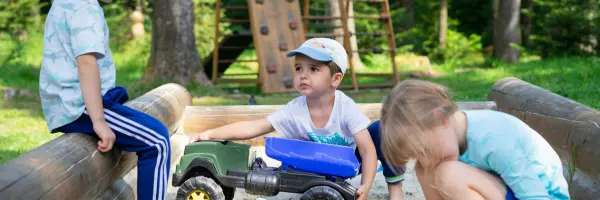
When educators draw on this understanding, playing on Country becomes more than outdoor play. It becomes a relationship with place. A way of learning that is grounded in observation, respect, and responsiveness to the land we are on. This approach is recognised in both the Early Years Learning Framework V2.0 and My Time, Our Place V2.0 (Department of Education, 2023a; 2023b), and described as place-based pedagogy. Long before these frameworks named it, First Nations peoples were already living this way of knowing, being, and doing on Country.
Knowledge shared by the Yirrganydji peoples of Far North Queensland, the Masig peoples of Masig (Yorke Island), the D’harawal peoples of New South Wales, and the Goodjinburra, Tul-gi-gin and Moorang-Moobar peoples of the Tweed Valley offers insight into how land signals when to move, when to rest, when to seek shade, and when to slow down. For example, when grass seeds dry and cicadas sing, Country is telling us to slow down, seek shade, drink water, and rest. As such our pedagogical practice could reflect this signal. As naturalist Luke Edwards writes, “the song of the cicada is the sound of summer in Australia” (Edwards, 2023).
Children can learn to read these cues too. With support and guidance, they develop body awareness alongside ecological literacy, learning not just about the environment, but with it, noticing how their bodies respond to heat, shade, wind, and rest. In this way, Country becomes an active teacher, shaping learning through lived experience rather than instruction alone.
One powerful way to deepen this connection is by co-creating a local seasonal calendar. This begins with noticing: which birds arrive or fall silent as the heat builds, which plants flower or rest, and how does the wind, insects, clouds, and light shift across the day. How do these observations differ from previous years e.g. did the migratory birds arrive late this year?
Where relationships already exist, inviting local Elders or Aboriginal and Torres Strait Islander community members to share how these patterns have long been read and responded to allows learning to become relational, humble, and grounded in respect. Over time, this shared noticing becomes a living curriculum, one that changes each year as children, educators, and communities deepen their relationship with place.
For inspiration and respectful guidance, the Indigenous Seasonal Calendar collections developed by CSIRO and the Bureau of Meteorology, in partnership with Aboriginal and Torres Strait Islander peoples, offer insight into the diversity and richness of seasonal knowledge across Australia. They remind us there is no single, universal template, only place-specific ways of listening and responding to Country.
Creating seasonal understanding in this way also builds trust with the land, with the children, and with ourselves as educators, potentially breaking down the barriers that the Queensland heat may present.
So what if heat wasn’t something to retreat from, but something to design with?
In the Northern Territory, many services have long embraced all-weather outdoor play. Educators respond through thoughtful adjustments to the rhythm of their day. Shade becomes essential infrastructure. Water play is embedded. Hydration and rest are part of the day. Access to both inside air-conditioned spaces and the outdoor natural environments support children to self regulate as needed. In these situations, practice reflects deep respect for children’s capacities and for Country’s cues while still managing their duty of care in situations of high UV and rising temperatures.
For Queensland educators, this is an invitation to reimagine responses grounded in shade, sustainability, hydration, and flexibility. Responses that honour children’s needs for movement, agency, safety, joy, and growing competence.
Naturally, having access to outdoor areas in the heat may also include simple, responsive adjustments such as monitoring ground temperatures and requiring protective footwear when surfaces become too hot for bare feet. Rather than retreating indoors entirely, small adaptations like these allow children to remain in relationship with place while ensuring comfort and safety.
These approaches cater for physical movement while also nurturing deeper holistic human needs. The need for autonomy through choice and movement is important. The need for regulation through rhythm and rest. The need for connection with others and with place. And the need to build mastery by learning how to adapt, persist, and care for oneself in changing conditions.
To truly play on Country, we must also learn from Country. This means embedding First Nations perspectives not as add-ons or special events, but as ways of seeing, noticing, and responding to the world.
When we shift from avoidance to relationship, we stop asking, “How do we escape the heat?” and begin asking, “How do we work with it?” And when we change our relationship with the weather, we do more than adapt programs, we expand children’s worlds.
Sun safety note
Phoenix Support for Educators supports outdoor, play-based, and relationship-driven learning on Country. The reflections and examples shared in this article are intended to sit alongside, not replace, each service’s SunSmart policy, risk assessments, and the requirements of the National Regulations.
While children and young people can develop interoceptive awareness and learn to notice cues such as heat, thirst, shade, and the need to rest, ultraviolet (UV) radiation cannot be seen or felt. For this reason, responsibility for monitoring UV levels and implementing sun protection always remains with educators.
Please continue to follow SunSmart guidance, including the use of shade, protective clothing, hats, sunscreen, and sunglasses where appropriate, whenever UV levels are 3 or above. Outdoor play should be adjusted as needed to ensure safety, comfort, and wellbeing for all children and young people. This may include monitoring ground and surface temperatures and implementing protective measures such as footwear or alternative shaded zones when surfaces become too hot.
An invitation for educators and leaders (DOWNLOADABLE COMING SOON)
References (APA 7th edition)
Alla, K. (2023). Nature play and child wellbeing. Australian Institute of Family Studies.
https://aifs.gov.au/resources/policy-and-practice-papers/nature-play-and-child-wellbeing
Australian Children’s Education and Care Quality Authority. (2024). Guide to the National Quality Framework (January 2025 update).
https://www.acecqa.gov.au/nqf/national-quality-framework
CSIRO. (n.d.). Indigenous knowledge: Seasonal calendars.
https://www.csiro.au/en/research/indigenous-science/Indigenous-knowledge/Calendars
Department of Education, Australian Government. (2023a). Belonging, being and becoming: The Early Years Learning Framework for Australia (Version 2.0).
https://www.education.gov.au/early-years-learning-framework
Department of Education, Australian Government. (2023b). My Time, Our Place: Framework for School Age Care in Australia (Version 2.0).
https://www.education.gov.au/my-time-our-place
Early Childhood Australia. (2022). Embedding Aboriginal and Torres Strait Islander perspectives in early childhood curricula.
https://www.earlychildhoodaustralia.org.au
Edwards, L. (2023). Cicadas: SEQ’s song of summer. Land for Wildlife South East Queensland.
https://www.lfwseq.org.au/cicadas-seq-song-summer
Frances, L., Quinn, F., Elliott, S., & Bird, J. (2024). Outdoor learning across the early years in Australia: Inconsistencies, challenges and recommendations. Australian Journal of Early Childhood.
https://doi.org/10.1007/s13384-023-00685-x
Kaaronen, R. O., Savonen, K., & Ojala, A. (2023). Nature connectedness and children’s self-regulation: An ecological approach. Frontiers in Psychology, 14, Article 1214532.
https://doi.org/10.3389/fpsyg.2023.1214532
Phoenix, S. (2024). Educator toolkit for behaviour (Rev. ed.). Phoenix Support Publishing.
Phoenix, S., & Phoenix, C. (2020). The Phoenix Cups: A cup filling story. Phoenix Support Publishing.
Rose, K. A., Morgan, I. G., Ip, J., Kifley, A., Huynh, S., Smith, W., & Mitchell, P. (2008). Outdoor activity reduces the prevalence of myopia in children. Ophthalmology, 115(8), 1279–1285.
https://doi.org/10.1016/j.ophtha.2007.12.019
Author: Annette Johnson