
Box construction has long been a core feature of my early childhood practice. It's open-ended, creative, supports so many vital aspects of learning and development, and let's be real - the best part is, it's FREE! But over the past 12 months, I've noticed I'm not often seeing box construction in action anymore. So I'm on a mission to revive it. Who's with me?
What actually IS box construction? Exactly what it sounds like - children's construction made from old boxes, tape, glue, and loose parts: bottle tops, fabric scraps, inner tubes, old magazines, cleaned juice or water bottles... the list goes on.
Box construction is:
- Process-driven - there is no required outcome.
- Open-ended - whatever idea their wild imagination sparks, box construction can take them there!
- Sustainable - we're saving items from landfill for the pursuit of education.
- Free! - ask families to contribute and request old food packaging from the kitchen.
- Flow-state supportive - once children know how to use these loose parts, they can quickly become deeply engaged in self-directed learning and creativity.
- A fabulous planning tool for STEAM, schema, and dispositions for learning.
How does box construction support learning?
- Creativity and imagination
- Expressing oneself using a range of media
- Non-linear thinking
- Resourcing one's own learning
- Fine motor skill development
- Problem solving, resilience, persistence, trial-and-error, cause-and-effect experimentation
- Numeracy via precursor mathematical concepts, e.g., comparison, attributes, pattern, and collection
- Literacy via opportunities for rich, descriptive serve-and-return conversation and scaffolding
- Collaboration, social negotiation, and sharing of ideas
- Ingenuity - using items in creative and unimagined ways
I know, it's exciting right! But before you go rushing to the kitchen to raid those empty cereal boxes, take a moment to hear some hard-won advice. I learnt a few lessons the difficult way, and here are the tips I wish someone had shared with me.
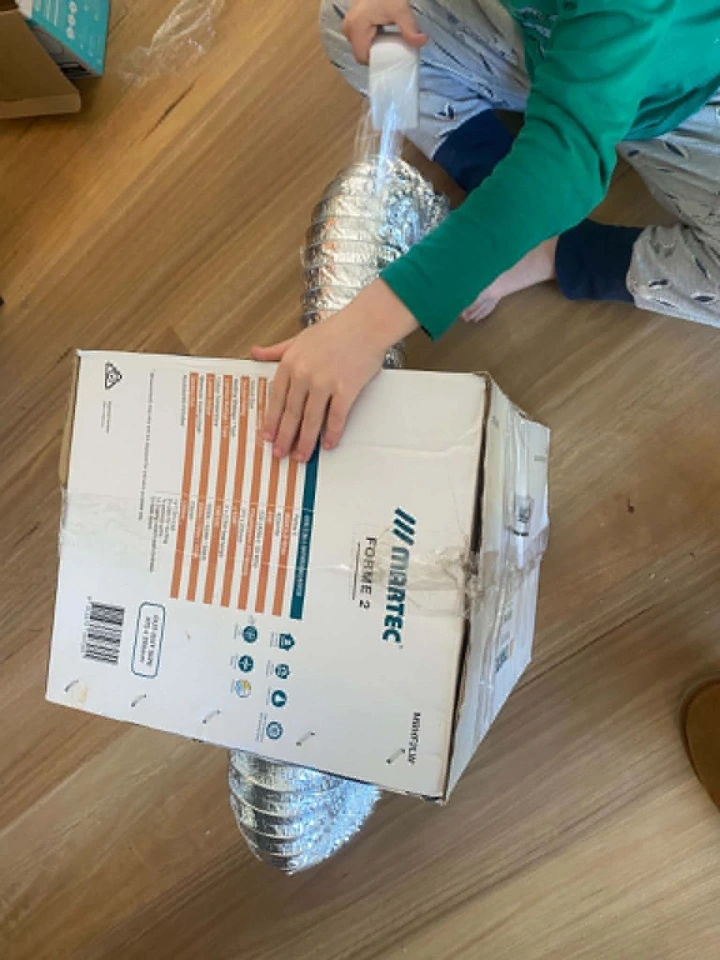
Getting started
- If your children have never built with boxes before, you'll need to teach them how. Factor this into your planning.
- Cover the base skills first - do they know how to use scissors? Masking tape? Cut old magazines up?
- Consider pre-preparing a few small provocations as examples. Children don't have to replicate these, but many will to begin with, before incorporating their own ideas.
- Think about your resources - are there enough to go around? If children always have to wait for the tape or scissors, it becomes a frustrating experience and quickly loses its appeal. When this happens, your hard planning work goes out the door (speaking from experience)
- Plan for educator support in this area over the first few days as children develop their box-construction skills. To do this, think critically about the rest of your environment - are other areas able to be used independently so that an educator can be present at this space?
Organisation is KEY - learn from my mistakes! I had what I thought was a brilliant idea. I used an old blanket box to store all the boxes so children could access them easily. "Nailed it!" I told myself... not so much. The children were also deep in an enclosing schema, and that blanket box was an irresistible space to squeeze their bodies into, totally squashing all the boxes in the process. Displaying them on a nearby shelf worked far better. A few more organisation tips:
- Children need space to work, with easy access to boxes, loose parts, and construction materials. Low shelves, room dividers, and an arts trolley can all help define and support the space.
- Chairs are often unnecessary and can actually impede workflow. Designing the area as a standing construction space also supports children's developing core strength, gross motor skills, and spatial understanding.
- You'll need space for creations to dry and for children to store their works-in-progress.
- A recycle bin in the area makes clean-up easy, as does a dustpan and broom.
A note on glue
- Glue sticks are expensive, unsustainable, and dry out the moment the lids go missing - and they will go missing. Just don't.
- PVA is super sticky but also runny.
- Cell mix (purchased as granules and made into a clear paste) is thick but doesn't hold well.
- The golden solution? A 50/50 mix of PVA and stiff cell mix - sticky enough to hold, thick enough to manage, with less mess to clean up.
A few other practical tips
- Masking tape can be torn with fingers, making it much easier to manage than sticky tape. It's also far easier to remove from little hands and arms - and yes, someone will inevitably wrap it around themselves.
- Squashed boxes are not inspiring. Keep the area clean, tidy, and functional, discarding squashed boxes into the recycling regularly.
- With children's permission, photograph their creations and add them to your inspiration board.
Safety considerations
Before you dive in, it's worth pausing to think through a few safety considerations - because even the most enthusiastic box construction setup needs a quick safety lens applied. Remember to think through;
- Allergies - consider the risk of food allergens from cross-contamination, e.g., raw egg residue on egg cartons, nut exposure from containers like cleaned-out peanut butter jars, or dried milk on bottle tops. Think about how you'll mitigate and manage these risks - agreeing on a list of items that will not be used is just one suggestion.
- Hygiene - the inside of toilet paper rolls is the obvious one here. Most services make an executive decision to leave these off the resource list, for fairly obvious reasons.
- Benefit-risk analysis - some services may need one for materials sourced from outside the service. Remember, the National Quality Framework requires us to use reasonable precautions to protect children from foreseeable risks of harm or hazard.
- A process for checking donated materials - double-check all resources brought in from families to ensure they are clean, suitable, and safe for use. I once missed a cleaned container that still had a warning sticker on it reading "keep out of reach of children." I check the container - all clear - but missed the label!
The container itself posed no direct safety risk, but it raised a bigger question worth sitting with - if children are using items containing a warning label what messages are we inadvertently sending about what's safe or appropriate for children to use? It was a powerful learning moment.
Box construction is one of those rare things in early childhood that ticks nearly every box - learning-rich, child-led, sustainability-friendly, and completely free. It asks very little of your budget and a little more of your organisation, but the payoff? Children deeply absorbed in their own creativity, building, problem-solving, and collaborating in ways that are genuinely joyful to witness. So dig out those cereal boxes, put the call out to families, and carve out a space in your environment. It doesn't have to be perfect from day one - in fact, some of the best learning will come from the moments it doesn't go to plan (hello, blanket box incident). Start small, stay curious, and let the children surprise you. Box construction has been a staple of quality early childhood practice for good reason. It's time to bring it back.